

Why getting the right Hermès sandal size matters
Getting the right Hermès sandal size saves money, prevents painful blisters, and preserves the leather. A properly fitted pair sits square on your foot: no toe overhang, no heel slip, and the H-strap lands where it should. Hermès sandals are not fast-fashion slides — their materials and construction mean fit choices are permanent and affect how the leather breaks in.
Hermès uses European (EU) sizing across most sandal lines, so guessing from a generic US/UK size can lead you astray. The brand’s signature designs — Oran, Izmir, Oasis — each interact differently with foot shape because of strap placement, sole thickness, and leather type. If you buy the wrong size and the leather is a rigid box calf or thick calfskin, you’ll end up with either painful pressure or loose, awkward movement. That’s why measuring and understanding model-specific tendencies is essential before committing.
Beyond comfort, fit affects appearance: the H cut and strap symmetry look best when the sandal fits the intended last. A slightly tight-but-correct fit will relax into a perfect shape as the leather adapts; a shoe that’s already loose won’t tighten. Treat measurement and model knowledge as preventive care for this investment piece.
How do I measure my foot for Hermès sandals?
Measure foot length and note the widest point; Hermès decisions hinge on length first, width second. Standing measurements taken at the end of the day, with socks if you plan to wear them, give the most reliable baseline for EU sizing.
To measure, place a sheet of paper on a hard floor, stand on it with full weight, mark the heel and the longest toe, then measure the distance between marks in millimeters. Repeat for both feet and use the larger measurement; many people have one foot slightly longer. Record the measurement in millimeters or centimeters — Hermès and most conversion charts map directly hermes platform sandals to foot length rather than to vague “small/medium” labels.
Also measure width: wrap a tape around the ball of the foot to get a circumference; note whether your foot is narrow, regular, or wide. The strap placement and toe-box openness of a given model will interact with width differently. If you have high arches, measure from heel to ball as well, because arch height affects how the strap crosses the instep and where pressure concentrates.
Finally, consider sock or footbed liners: if you plan to wear thin socks, add about 1–2 mm; for thicker footbeds or orthotics, add more as needed. Keep these numbers handy when you compare to the Hermès size chart and to model-specific notes.
Hermès sizing chart: EU to US/UK and foot length
Hermès lists sandals in EU sizes; convert using foot-length mapping to choose your best EU match. Use the larger of your two feet and match the millimeter measurement to the table row closest to it.
| EU | US Women (approx.) | UK (approx.) | Foot length (mm) |
|---|---|---|---|
| 35 | 5 | 2.5 | 225 |
| 36 | 6 | 3.5 | 230 |
| 37 | 6.5–7 | 4–4.5 | 235 |
| 38 | 7.5–8 | 5–5.5 | 240 |
| 39 | 8.5–9 | 6–6.5 | 245 |
| 40 | 9.5–10 | 7–7.5 | 250 |
| 41 | 10.5 | 8 | 255 |
This table is a practical conversion tool: always round to the nearest EU size based on your measured millimeters, then check model-specific notes. If your measurement sits between two sizes, consider the model and leather: pick the smaller EU size for soft, stretchable leathers; pick the larger for rigid leathers and for wide feet. Remember that Hermès rarely offers half sizes on ready-to-wear sandals; you must choose the closest full EU size or consult a boutique for options.
Do Hermès models fit differently?
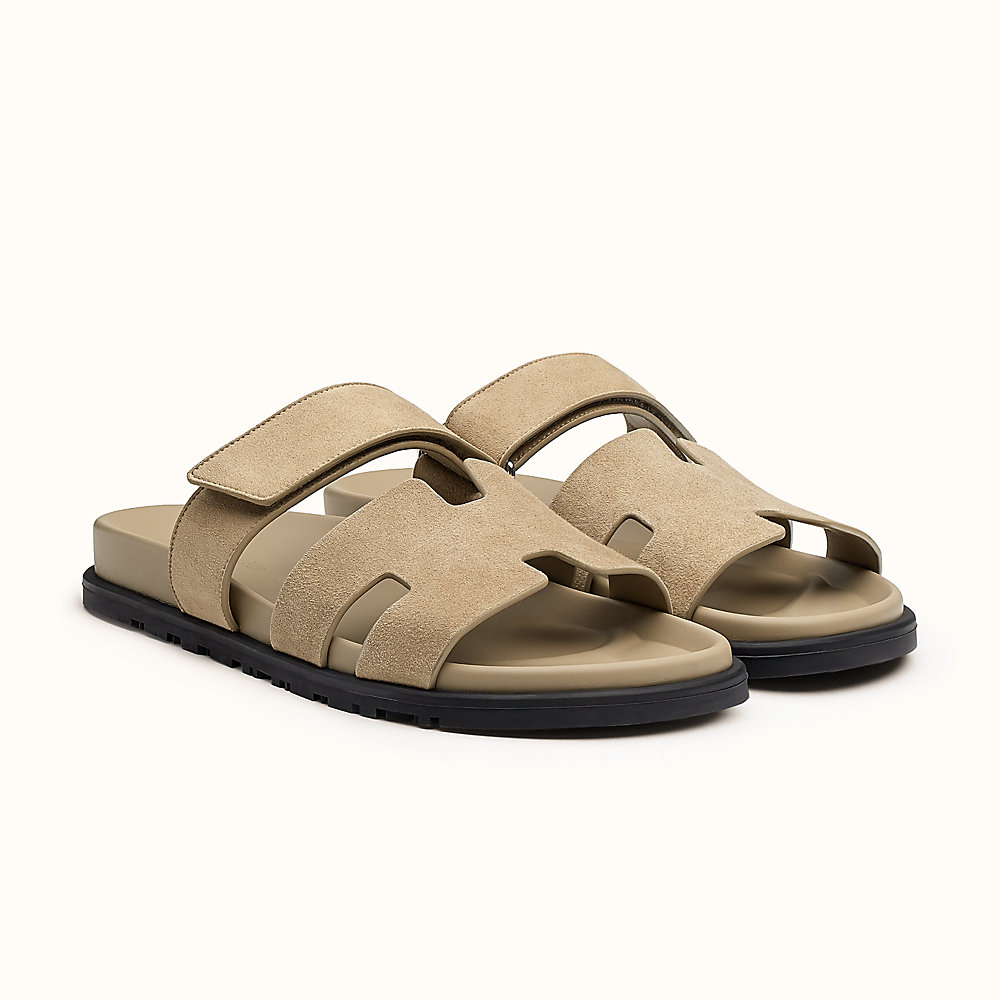
Yes — Oran, Izmir, and Oasis can all fit differently even when they’re the same EU number because their straps, soles, and lasts differ. Oran’s H-strap sits across the forefoot; Izmir’s double straps alter forefoot pressure; Oasis is chunkier with more sole depth.
Oran: many wearers find the Oran true to size in length but narrow across the H strap, so those with wide forefeet may need to move up a half size in equivalent measures or choose a softer leather that stretches. Izmir: the two straps usually distribute pressure more evenly; some users report a slightly roomier feel but that varies by foot shape. Oasis and other sandal styles with thicker soles can feel higher and firmer underfoot; a slightly more secure fit helps avoid heel slip on those platforms.
Model-specific tolerances matter: strap position determines where the foot is held. If the H sits too far back, toes will overhang; if it sits too close to the toes, pressure will form across the joint. Try to visualize where your longest toe meets the sole edge and where the strap would cross — that determines whether a size will work long-term, because leather will move but hardware and sole shape do not.
When in doubt, consult a boutique fitting or request accurate in-hand footbed measurements from a retailer; asking for the millimeter length of the inner sole for a given EU size gives you a precise check against your foot length and removes guessing.
Leather, width and arch: how they change fit plus expert tip and little-known facts
Leather type, foot width, and arch height change how a Hermès sandal will fit more than a single size number. Some leathers are forgiving and stretch; others hold shape and force you to size differently.
Calfskin and box calf hold structure and will not give much — if your measurement is borderline, choose the larger EU size for these leathers. Goatskin and lambskin are softer and will relax significantly with wear, often by 3–5 mm across the instep but less in length; with these, staying with the measured EU size is usually fine. Wide feet need a combination of softer leather and a size that prevents pressure at the H strap; narrow feet may prefer a snug fit that will soften rather than a loose fit that never molds well.
Arch height affects strap tension and perceived length. If you have high arches, the strap can sit higher on the foot, making the foot feel shorter inside the sandal; that sometimes requires moving up a half- EU size. If you have flat feet, the sole may feel longer because the foot rests flatter; try the standard size first and assess toe overhang and heel slip after standing and walking for several minutes.
\”Expert tip: Don’t automatically size up because a leather strap feels tight standing still. Measure your foot, match the millimeters to the EU chart, and remember that soft leathers will spread. Only size up if your toes hit the sole edge or the heel slips when you walk — minor instep pressure often disappears after a few wears.\” — Fit specialist quote.
Three little-known but verified facts: First, Hermès produces footwear in several countries — France, Spain, Italy, and Portugal — and production origin can slightly influence last and leather handling; second, the Oran’s signature H cut is positioned intentionally to lengthen the appearance of the foot, so strap location affects perceived fit as much as true fit; third, different leather finishes stretch differently: pebble-grain and goat leathers relax faster than glossy box calf, which can remain snug for many wears. Keep these in mind when choosing between materials.
When you’ve completed measurement, conversion, and model checks, try the pair on at the end of the day, stand, walk several steps, and test for even pressure across the foot. Accurate measurement plus model-aware choice beats guesswork and preserves the look and lifespan of your Hermès sandals.